 HF Sphinx Documentation
UML Notes & Examples
This file demonstrates Composition and Aggregation in UML, with corresponding C# code examples.
Composition Example
Description:
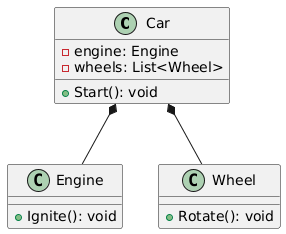
In composition, the lifetime of the parts depends on the whole.
A Car owns an Engine and Wheel’s. If the Car is destroyed, its parts are destroyed automatically.
// Car composition example
Car car = new Car();
car.Start(); // Uses its engine and wheels internally

public class Car
{
    private Engine engine;
    private List<Wheel> wheels;

    public Car()
    {
        engine = new Engine(); // created together with Car
        wheels = new List<Wheel> { new Wheel(), new Wheel(), new Wheel(), new Wheel() };
    }

    public void Start()
    {
        engine.Ignite();
        foreach (var wheel in wheels) wheel.Rotate();
    }
}

public class Engine
{
    public void Ignite() { /* Engine only exists inside Car */ }
}

public class Wheel
{
    public void Rotate() { /* Wheel only exists inside Car */ }
}
Aggregation Example
Description:
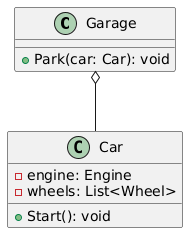
In aggregation, the parts can exist independently of the whole.
A Garage can store Car’s, but Car’s exist independently they can live before and after being in a Garage.
// Cars exist independently of the Garage
Car car1 = new Car();
Car car2 = new Car();

// Create a Garage and park cars
Garage garage = new Garage();
garage.Park(car1);
garage.Park(car2);

// Cars still exist even if the garage is destroyed
garage = null;
car1.Start();
car2.Start();

public class Garage
{
    private List<Car> cars = new List<Car>();

    public void Park(Car car)
    {
        cars.Add(car);
    }
}

public class Car
{
    private Engine engine;
    private List<Wheel> wheels;

    public Car()
    {
        engine = new Engine();
        wheels = new List<Wheel> { new Wheel(), new Wheel(), new Wheel(), new Wheel() };
    }

    public void Start()
    {
        engine.Ignite();
        foreach (var wheel in wheels) wheel.Rotate();
    }
}

public class Engine
{
    public void Ignite() { /* Engine exists independently in Car */ }
}

public class Wheel
{
    public void Rotate() { /* Wheel exists independently in Car */ }
}